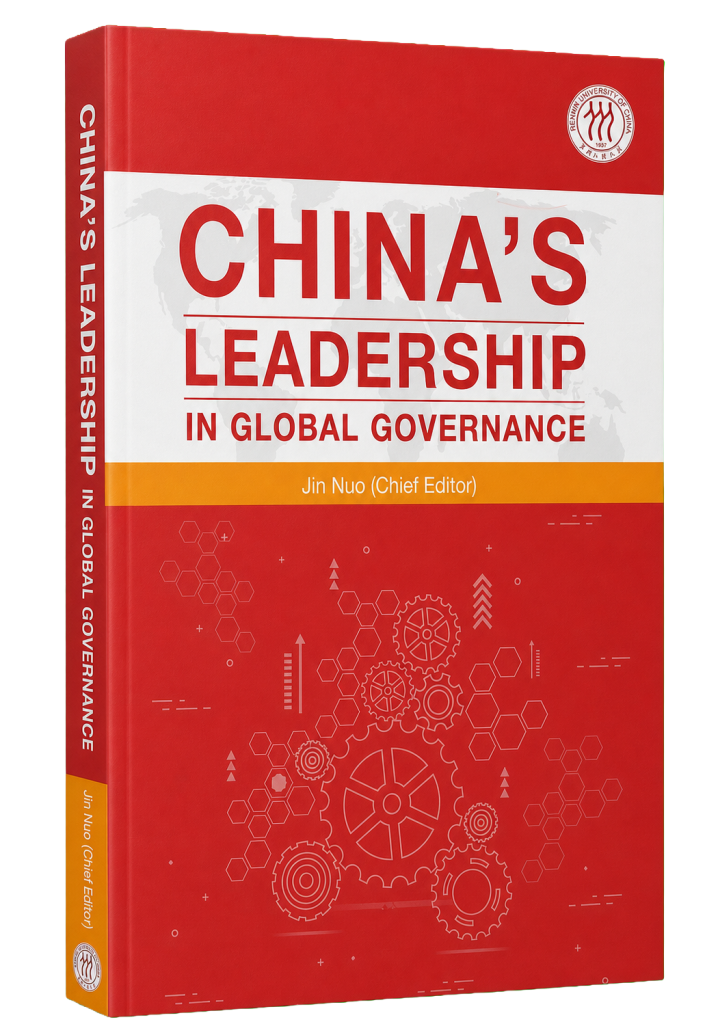
Professor Jin Nuo is a highly distinguished scholar and academic leader in China, recognized for her extensive contributions to education, political theory, and global governance. Born in 1956, she completed her doctoral studies at Renmin University of China, where she later served as the Communist Party Secretary (the top executive position) from 2013 to 2021. Throughout her prominent career, Professor Jin has held key leadership positions, including Deputy Director of the Higher Education Department at the Ministry of Education of China and Vice Governor of Xinjiang Uygur Autonomous Region. She is currently a senior professor and doctoral supervisor at Renmin University of China, focusing on ideological and political education, contemporary Chinese governance, and international relations.
As the Chief Editor of China’s Leadership in Global Governance, Professor Jin provides an authoritative and comprehensive analysis of China’s evolving role on the world stage. The book explores how China actively engages with, contributes to, and reshapes global institutions, climate policy, and international economic cooperation under the framework of a “Community with a Shared Future for Mankind.” Synthesizing rigorous academic insights with practical policy perspectives, her work serves as an essential guide for scholars, diplomats, and students interested in contemporary international relations, Chinese foreign policy, and the dynamics of modern global governance.
Amir Salehi Taleghani is a distinguished Iranian translator, researcher, and educator with an unusually broad and interdisciplinary academic background. He holds a Bachelor’s degree in Physics and Laboratory Sciences, as well as graduate degrees in English Language and Literature and Clinical Psychology. He is a member of the Iranian Psychology and Counseling Organization and the American Psychological Association (APA). His own academic research has focused on the AI-based diagnosis of schizophrenia — a pioneering intersection of clinical psychology and artificial intelligence. This unique combination of scientific, literary, and psychological expertise has made him exceptionally well-suited for translating complex works in the humanities, psychology, and interdisciplinary studies. Over the years, he has translated numerous scientific titles, several of which have received prestigious awards, including the Book of the Year award in Iran. The direct connection between his research in AI-driven psychiatric diagnosis and the subject matter of certain translations has turned his work into a uniquely specialized and insightful experience.
Born in Tehran in 1966 or 1967, Taleghani began his professional life as a teacher in Tehran schools, and it was there that he first identified the need for high-quality educational resources in Persian. His early career as an educator, combined with his scientific training, led him to select and translate books that would genuinely benefit young learners. Over decades, he has produced an exceptionally wide range of translated works — from multi-volume series on life skills, the human body, energy resources, and scientific experiments (with air, water, magnets, and light), to encyclopedias of science and space, and titles such as The Amazing World of Water, 1001 Scientific Questions and Answers for Children, and Where Does Rubbish Go? His translations have been published by Iran’s most respected educational publishers, including Mehrab Ghalam, Ofoq, Ghadyani, Navaye Madreseh, and Anjam Ketab. Beyond books, he has contributed to educational magazines like Roshd Danesh Amouz. While his name may not appear on individual award lists, the repeated collaboration of award-winning publishers speaks clearly to the quality and lasting value of his work. Amir Salehi Taleghani’s enduring legacy lies in his quiet, persistent effort to nurture scientific curiosity, critical thinking, and cross-disciplinary understanding among generations of Iranian readers.